
Employee benefits are no longer nice-to-haves. In competitive talent markets across Nigeria and Africa, the types of employee benefits an organisation offers have become a core part of business strategy.
This shift reflects a move from a transactional pay‑for‑work model to a total rewards approach that strengthens an organisation’s resilience to infrastructure weaknesses, the ‘brain drain,’ and workforce instability during periods of economic uncertainty.
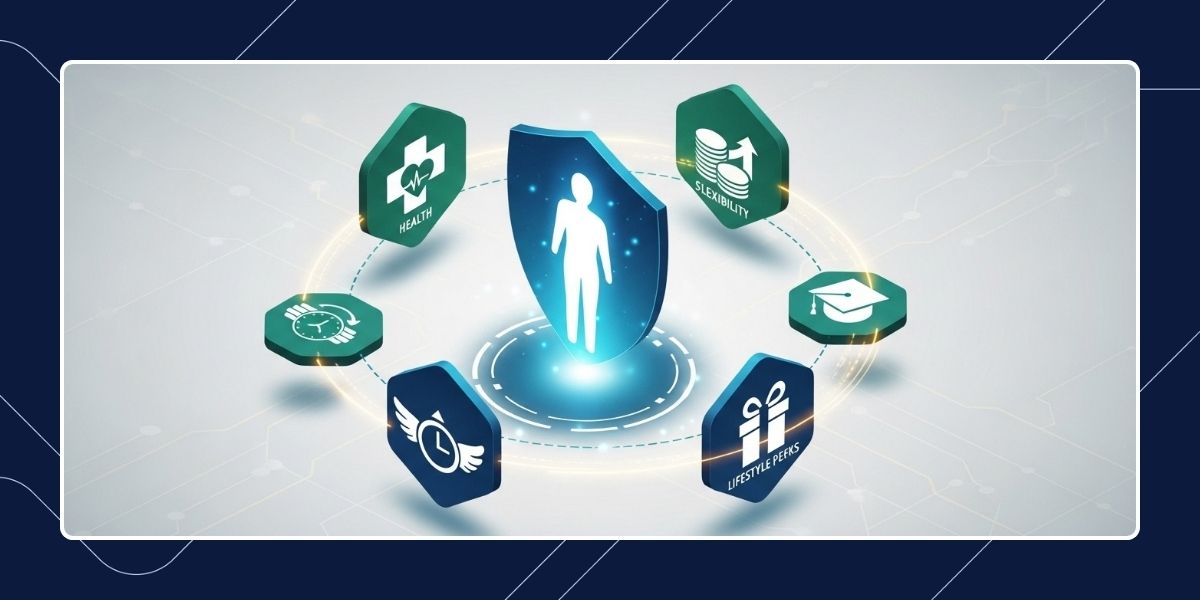
The aim of this article is to provide a strategic framework for organising the various types of employee benefits into clear, business-relevant categories: statutory, financial, wellness, growth, flexibility, and fringe perks.
By mapping these types to the local regulatory landscape and common practices in Nigeria, this guide offers a practical roadmap for HR leaders to design or benchmark a package that truly resonates with a modern African workforce, whether you are designing a benefits package from scratch or benchmarking an existing one.
What Are the Types of Employee Benefits?
Employee benefits are non-monetary or indirect compensation provided in addition to base salary.
While benefits in high-income economies often focus on lifestyle perks, the African context requires a “human-centric” approach that bridges the gap between public infrastructure and the high cost of living.
Strategic design is about the “psychological contract” between employer and employee. While a competitive salary starts the conversation, the benefits package often dictates long-term loyalty and emotional investment.
Research indicates that nearly 78% of African professionals view benefits as a crucial factor when evaluating job opportunities, and organisations with optimised offerings can see turnover reductions of up to 50%.
Employee benefits typically serve three main purposes:
- Financial security: protecting employees against health risks, retirement, and income disruption
- Well-being and support: improving physical, mental, and emotional health
- Talent management: attracting, motivating, and retaining skilled employees
Organizations offer various types of employee benefits, ranging from legally required protections (such as pensions or workers’ compensation) to discretionary offerings like training budgets, flexible work, or lifestyle perks.
Statutory/Mandatory Benefits in Nigeria
While statutory requirements vary by company size and sector, Nigerian employers must plan for a core set of mandatory benefits.
It is important for HR leaders to note that the Labour Act primarily defines the rights of “workers” in manual or clerical roles, while benefits for professional, administrative, executive, and technical employees in the private sector are largely governed by employment contracts, which often exceed statutory minimums in order to remain competitive.
The Contributory Pension Scheme
Under Nigeria’s pension framework, employers and employees contribute a combined minimum of 18% of monthly emoluments to a Retirement Savings Account (RSA).
This is typically structured as a higher employer contribution alongside an employee deduction.
| Contribution Component | Minimum Statutory Rate | Base Calculation |
| Employer Contribution | 10% of monthly emoluments | Basic Salary + Housing + Transport Allowances. |
| Employee Contribution | 8% of monthly emoluments | Basic Salary + Housing + Transport Allowances. |
Remittance is strictly required within seven working days of salary payment. Failure to comply results in a penalty of at least 2% of the unpaid amount for each month the default persists.
Employee Compensation Scheme (NSITF)
Employers are required to contribute a percentage of payroll to the Employees’ Compensation Fund, managed by the NSITF. This scheme provides financial compensation for workplace-related injury, illness, disability, or death.
- Contribution: Employers must contribute 1% of their total monthly payroll.
- Source: This is 100% employer-funded and cannot be deducted from employee salaries.
National Health Insurance (NHIA)
The National Health Insurance Authority (NHIA) Act 2022 mandates health insurance for every Nigerian and legal resident.
Formal sector employers (typically those with 5 to 10 or more staff) participate via payroll contributions, usually 10% from the employer and 5% from the employee.
For the informal sector or small businesses with fewer than 10 employees, the NHIA provides the Group Individual and Family Social Health Insurance Programme (GIFSHIP).
Most private-sector organisations work with private Health Maintenance Organisations (HMOs) to manage these plans. These HMOs act as intermediaries between the employer, the regulatory agency (NHIA), and healthcare providers.
Statutory Leave Entitlements
The Labour Act provides minimum standards for various protected absences. Organisations often extend these for professional staff via internal policies.
| Leave Type | Minimum Requirement | Eligibility/Conditions |
| Annual Leave | 6 working days (Paid) | Minimum 12 months of continuous service. |
| Sick Leave | 12 working days (Paid) | Requires a medical certificate from a licensed professional. |
| Maternity Leave | 12 weeks (at least 50% Pay) | Female employees; requires medical certificate. |
| Public Holidays | 11–13 Days (Paid) | Determined by the Federal Government annually. |
Industrial Training Fund (ITF) Contributions
For organisations with 5 or more employees or an annual turnover of ₦50 million or more, the ITF Act requires a contribution of 1% of the total annual payroll. Companies can recover up to 50% of their contributions if they provide evidence of structured training programs for their staff.
Why statutory benefits matter to HR
Statutory benefits directly affect your payroll register, monthly remittances, employee trust, and employer reputation. Non-compliance can lead to penalties, audits, and employee dissatisfaction.
HR best practice: Treat statutory benefits as a fixed cost baseline, automate remittances through payroll software such as PaidHR, and clearly communicate these benefits to employees so they understand their value.
Financial and Insurance Benefits
In high-inflation environments like Nigeria, financial benefits serve as an essential buffer for employee purchasing power. These benefits go beyond the base salary to provide long-term security and immediate liquidity.
Group Life Insurance
Under the Pension Reform Act, organisations with 15 or more employees are legally required to provide a life insurance policy valued at a minimum of three times the employee’s annual total salary.
If the employer fails to maintain this policy and an employee dies, the organisation is legally mandated to settle the claim directly from its own funds.
Bonuses and the 13th Month Salary
The “13th-month salary” is not a statutory requirement in Nigeria, but it has become a powerful “psychological contract” item.
In many sectors, it is viewed as a predictable year-end entitlement to help employees manage the high costs of the festive season. HR leaders must clearly define the calculation method (which is typically one full month of base salary) to maintain consistency and trust.
Earned Wage Access (EWA) and Staff Loans
Forward-thinking HR teams are adopting Earned Wage Access (EWA). This allows employees to access a percentage of their already-earned wages before the official payday to handle daily expenses like fuel and transport without hurting company cash flow.
Additionally, types of employee benefits centered on financial assistance, such as staff loans and salary advances, are becoming increasingly common to help staff manage unexpected expenses.
Allowances as Strategic Differentiators
In Nigeria, allowances are often used to address specific infrastructure hurdles.
- Housing Allowance: Widespread in urban centres like Lagos and Abuja, where rent costs are high.
- Transport and Mobility: Due to poor public transit, many firms provide a transport stipend, staff buses or subscribe to Shuttlers.
- Data and Power Stipends: With hybrid work, stipends of ₦10,000 – ₦25,000 are increasingly common to cover the cost of petrol and high-speed data.
While common, these allowances are only a small part of the various types of employee benefits available to workers. Others include:
Wellness and Support Benefits
Nigerian companies lose an estimated ₦10 billion annually due to absenteeism and “presenteeism” (being at work but unproductive) caused by stress.
- Suggestion: Partner with digital mental health providers to offer confidential counselling. It’s more discreet and has higher uptake in our culture.
- Nice Perk: Introduce “Wellness Days”, which will be one day a quarter where the whole office recharges. It normalises rest and is a high-impact, zero-cost retention tool.
Physical Wellness and Disease Management
Africa faces a “dual burden” of Malaria/TB alongside rising cases of hypertension and diabetes. Untreated high blood pressure is a silent productivity killer.
Suggestion: Building a clinic or hospital just for your staff is going to be a Herculean task. However, employers and HR teams can host an annual “Office Health Day.”
Partner with your HMO to bring a mobile medical team to the office for basic screenings (BP, Sugar, BMI).
Nice Perk: Choose an HMO that offers Telehealth/Virtual Doctor Access. This saves your staff half a day of hospital wait times for minor issues like prescriptions or malaria treatment.
Growth and Career Benefits
In a “Japa” economy, employees stay where they are growing. Career development can be one of the types of employee benefits that becomes your strongest retention lever.
Professional Development and L&D Programs
Competitive packages often include:
- Paid Training and Certifications: Budgeted support for industry-recognised credits (e.g., NIPR, CIPM, ICAN).
- Mentorship Programs: Pairing high-potential staff with senior leaders.
- Tuition Reimbursement: Programs that fund degrees in exchange for a committed period of service.
Flexibility and Work-Life Benefits
Flexibility in African megacities is a direct response to infrastructure deficits. A flexible schedule that avoids peak Lagos traffic can save 4–6 hours of unproductive time daily.
Hybrid and Asynchronous Work Models
The shift toward flexibility includes:
- Remote/Hybrid options: Allowing employees to work from home part-time or providing “Remote Fridays”.
- Asynchronous hours: Valued by Gen Z and tech workers, allowing productivity to dictate the schedule.
- Later start times: Improving mental well-being for employees with long commutes.
Enhanced Parental and Caregiver Leave
Modern Nigerian firms like Interswitch and Access Bank are expanding beyond statutory minimums.
- Paid Paternity Leave: Usually 2–5 days to support new fathers.
- Adoption and surrogacy leave: Aligning with international standards of inclusivity.
- Extended unpaid leave: Providing job security for those managing complex family responsibilities.
Fringe Benefits and Perks
Fringe benefits provide critical cultural alignment and lifestyle support, serving as the “extras” that define company culture and acknowledge an organisation’s broader social responsibilities.
Burial Support and Bereavement
Funerals are high-cost cultural obligations in Africa. Employers often provide burial grants or specialised funeral insurance that offers quick payouts (often within 48 hours) to manage immediate costs.
Commuter and Lifestyle Perks
- Company Equipment: High-end laptops, noise-cancelling headphones, and smartphones.
- Meal Subsidies: Providing subsidised lunch or on-site catering to ensure the team is well-nourished.
- Festive Hampers: End-of-year support featuring essential items (rice, oil, protein) that serve as a lifeline for family celebrations.
How to Categorise Employee Benefits for Your Organisation
Copy-and-paste benefits rarely solve the problems they’re meant to address.
To transform total rewards into a targeted investment rather than a scattered set of perks, HR leaders must move from reactive decisions to intentional design.
The Benefit Value Framework
When auditing your types of employee benefits, categorise them into these three strategic tiers:
- Foundational (Statutory/Non-Negotiable):
These are items like Pension, NSITF, and basic NHIA compliance. Without these, your organisation faces legal and reputational risks.
- Stability (Human-Centric/Life Buffers):
These address daily African pain points. Transport stipends (₦10,000-₦15,000), food support and Earned Wage Access (EWA) for liquidity.
- Differentiators (Value-Based/Culture):
These are the perks that win the talent war. Examples include Interswitch’s Spousal Allowance, MTN’s Employee Share Ownership Plans (ESOPs), or international HMO coverage.
A Practical Four-Step Design Framework
- Step 1: The Needs-Gap Audit
Survey your team using pulse polls to break down needs by demographic.
A younger Gen Z developer values a data stipend and remote work, while an older manager values retirement matching and executive health checks.
- Step 2: Competitive Benchmarking
Make sure you match your competition for talent, not simply the market.
If you are a startup competing with banks, flexibility and equity are your levers; if you are an SME competing with multinationals, local support like school fee loans becomes your edge.
- Step 3: Strategic Allocation (Tiered Budgeting)
Allocate a fixed percentage of total compensation (typically 15%-25%) to benefits.
Build a starter pack for entry-level staff and a retention pack for high-performers that includes paid certifications and profit-sharing.
- Step 4: Technology and Operational Check.
Ensure the benefits can be delivered thumb-friendly. While internet uptake appears strong, computer penetration is limited and fixed household internet is virtually non-existent (RIA Survey data suggests only 3.4% of households have a fixed connection).
Because the majority of users (62%) go online primarily via mobile handsets due to inadequate power and the absence of fixed lines, enrollment and leave requests must be manageable via an app, not desktop portals.
This framework helps HR leaders move from reactive benefit decisions to intentional design.
Examples of Employee Benefits by Business Size
Small businesses (1–50 employees)
- Statutory benefits and basic pension compliance
- Health insurance or NHIS top-ups
- Flexible work arrangements
- Modest learning stipends
Mid-market organisations (50–250 employees)
- Full statutory compliance
- Comprehensive HMO plans
- Structured training budgets
- Performance bonuses and allowances
Large enterprises (250+ employees)
- Enhanced pension and retirement plans
- Extensive health, wellness, and Employee Assistant Program (EAP) offerings
- Leadership development programmes
- Executive and long-service benefits
How HR Leaders Can Implement Benefits Effectively
To move from plan to action, HR leaders should focus on these four simplified steps for the coming year.
1. Update for the 2026 Nigeria Tax Act (NTA)
The new tax rules can give your employees an “automatic raise” if your payroll is set up correctly.
- The ₦0 Tax Zone: Anyone earning ₦800,000 or less per year is now 100% exempt from PAYE tax.
- The Rent Relief: Employees can deduct 20% of their annual rent from their taxable income (capped at ₦500,000). Ensure your team knows how to submit their receipts to get this relief applied to their monthly pay.
- Zero-Rated Perks: Food, education, and health are now zero-rated for VAT. You can save the company money by choosing benefits in these categories, like meal vouchers or tuition support.
2. Automate to Humanise
Don’t waste time on manual calculations or chasing bank receipts. Use a modern platform like PaidHR to automate your monthly pension and tax remittances.
This stops the 10% late-payment fines and lets you focus on your people instead of spreadsheets.
3. Mobile-First Communication
If a benefit is hard to find, it doesn’t exist for your staff. You can create a digital employee handbook that is easy to read on a phone.
Employees will spend less than an hour reviewing benefits, so make sure yours are written in plain, simple language that shows the value immediately.
4. Audit Your Perks
Perks are an investment. If they aren’t being used, they are a waste of budget.
Look at your data. If only 2% of staff use the gym discount, but 80% are asking for transport support, move that budget. Review your utilisation every quarter to make sure your investment is actually helping with retention.
By aligning your benefit types with the local realities of 2026, you build a workforce that is not just compliant but fiercely loyal and resilient.